Showing posts with label police. Show all posts

Tuesday, August 26, 2014

Miley Cyrus' Homeless VMAs Date Has Record, Warrant Out for Arrest

The once-homeless man who was Miley Cyrus' date at the MTV VMAs on Sunday has a police record and an open warrant out for his arrest.

Jesse Helt, 22, gave a speech and accepted the award for Best Video on behalf of Cyrus on Sunday night at the MTV VMAs.

Helt spoke about youth homelessness in America and had Cyrus, 21, in tears.

However, Helt has a warrant out for his arrest in his native Oregon.

Court records obtained by ABC News showed he was arrested for "criminal mischief" and "attempted burglary" in 2010. The burglary charge was changed to "criminal trespass" later that year. The records showed that Helt admitted he tried to enter an apartment by breaking a window amid a "marijuana" dispute.

He pleaded guilty/no contest to the charges and received probation. An arrest warrant was issued in 2011 when Helt violated probation by failing to report to scheduled probation meetings and failing to complete urine tests, among other charges.

Jon Troike, a judicial services specialist, told ABC News that Helt would be arrested if the police found him, and they might find him right in Oregon.

Helt's mother, Linda Helt, said yesterday that he would be flying home later that night.

Helt grew up in Salem, Oregon, also according to his mother.

Tuesday afternoon, Cryus tweeted, saying "People who are homeless have lived very hard lives. Jesse included. I hope that this can be the start of a national conversation about youth homelessness and how to end it."

She continued, "Does looking down upon the homeless help people excuse their inaction?"

Cyrus and Helt connected through My Friend’s Place -- a Los Angeles center for homeless youth, helping them to get food and shelter.

Sunday, August 24, 2014

UNARMED IN AMERICA A MUST WATCH VIDEO, MICHAEL BROWN, ERIC GARNER AND MANY OTHERS

CLICK TO WATCH Unarmed in America! Alarming Video

Ferguson Cops Were Caught in a Bloody Lie: The officers got the wrong man, but charged him anyway—with getting his blood on their uniforms after beating him to a pulp

The officers got the wrong man, but charged him anyway—with getting his blood on their uniforms. How the Ferguson PD ran the town where Michael Brown was gunned down.
Police in Ferguson, Missouri, once charged a man with destruction of property for bleeding on their uniforms while four of them allegedly beat him.

“On and/or about the 20th day of Sept. 20, 2009 at or near 222 S. Florissant within the corporate limits of Ferguson, Missouri, the above named defendant did then and there unlawfully commit the offense of ‘property damage’ to wit did transfer blood to the uniform,” reads the charge sheet.

The address is the headquarters of the Ferguson Police Department, where a 52-year-old welder named Henry Davis was taken in the predawn hours on that date. He had been arrested for an outstanding warrant that proved to actually be for another man of the same surname, but a different middle name and Social Security number.

“I said, ‘I told you guys it wasn’t me,’” Davis later testified.

He recalled the booking officer saying, “We have a problem.”

The booking officer had no other reason to hold Davis, who ended up in Ferguson only because he missed the exit for St. Charles and then pulled off the highway because the rain was so heavy he could not see to drive. The cop who had pulled up behind him must have run his license plate and assumed he was that other Henry Davis. Davis said the cop approached his vehicle, grabbed his cellphone from his hand, cuffed him and placed him in the back seat of the patrol car, without a word of explanation.

But the booking officer was not ready just to let Davis go, and proceeded to escort him to a one-man cell that already had a man in it asleep on the lone bunk. Davis says that he asked the officer if he could at least have one of the sleeping mats that were stacked nearby.

”He said I wasn’t getting one,” Davis said.

Davis balked at being a second man in a one-man cell.

“Because it’s 3 in the morning,” he later testified. “Who going to sleep on a cement floor?”

The booking officer summoned a number of fellow cops. One opened the cell door while another suddenly charged, propelling Davis inside and slamming him against the back wall.

“I told the police officers there that I didn’t do nothing, ‘Why is you guys doing this to me?’” Davis testified. “They said, ‘OK, just lay on the ground and put your hands behind your back.’”

Davis said he complied and that a female officer straddled and then handcuffed him. Two other officers crowded into the cell.

“They started hitting me,” he testified. “I was getting hit and I just covered up.”

The other two stepped out and the female officer allegedly lifted Davis’ head as the cop who had initially pushed him into the cell reappeared.

“He ran in and kicked me in the head,” Davis recalled. “I almost passed out at that point… Paramedics came… They said it was too much blood, I had to go to the hospital.”

A patrol car took the bleeding Davis to a nearby emergency room. He refused treatment, demanding somebody first take his picture.

“I wanted a witness and proof of what they done to me,” Davis said.

He was driven back to the jail, where he was held for several days before he posted $1,500 bond on four counts of “property damage.” Police Officer John Beaird had signed complaints swearing on pain of perjury that Davis had bled on his uniform and those of three fellow officers.

The remarkable turned inexplicable when Beaird was deposed in a civil case that Davis subsequently brought seeking redress and recompense.

“After Mr. Davis was detained, did you have any blood on you?” asked Davis’ lawyer, James Schottel.

“No, sir,” Beaird replied.

Schottel showed Beaird a copy of the “property damage” complaint.

“Is that your signature as complainant?” the lawyer asked.

“It is, sir,” the cop said.

“And what do you allege that Mr. Davis did unlawfully in this one?” the lawyer asked.

“Transferred blood to my uniform while Davis was resisting,” the cop said.

“And didn’t I ask you earlier in this deposition if Mr. Davis got blood on your uniform?”

“You did, sir.”

“And didn’t you respond no?”

“Correct. I did.”

Beaird seemed to be either admitting perjury or committing it. The depositions of other officers suggested that the “property damage” charges were not just bizarre, but trumped up.

“There was no blood on my uniform,” said Police Officer Christopher Pillarick.

And then there was Officer Michael White, the one accused of kicking Davis in the head, an allegation he denies, as his fellow officers deny striking Davis. White had reported suffering a bloody nose in the mayhem.

“Did you see Mr. Davis bleeding at all?” the lawyer, Schottel, asked.

“I did not,” White replied.

“Did Mr. Davis get any blood on you while you were in the cell?” Schottel asked.

“No,” White said.

The contradictions between the complaint and the depositions apparently are what prompted the prosecutor to drop the “property damage” allegation. The prosecutor also dropped a felony charge of assault on an officer that had been lodged more than a year after the incident and shortly after Davis filed his civil suit.

Davis suggested in his testimony that if the police really thought he had assaulted an officer he would have been charged back when he was jailed.

“They would have filed those charges right then and there, because that’s a major felony,” he noted.

Indisputable evidence of what transpired in the cell might have been provided by a surveillance camera, but it turned out that the VHS video was recorded at 32 times normal speed.

“It was like a blur,” Schottel told The Daily Beast on Wednesday. “You couldn’t see anything.”

The blur proved to be from 12 hours after the incident anyway. The cops had saved the wrong footage after Schottel asked them to preserve it.

Schottel got another unpleasant surprise when he sought the use-of-force history of the officers involved. He learned that before a new chief took over in 2010 the department had a surprising protocol for non-fatal use-of-force reports.

“The officer himself could complete it and give it to the supervisor for his approval,” the prior chief, Thomas Moonier, testified in a deposition. “I would read it. It would be placed in my out basket, and my secretary would probably take it and put it with the case file.”

No copy was made for the officer’s personnel file.

“Everything involved in an incident would generally be with the police report,” Moonier said. “I don’t know what they maintain in personnel files.”

“Who was in charge of personnel files, of maintaining them?” Schottel asked.

“I have no idea,” Moonier said. “I believe City Hall, but I don’t know.”

Schottel focused on the date of the incident.

“On September 20th, 2009, was there any way to identify any officers that were subject of one or more citizens’ complaints?” he asked.

“Not to my knowledge,” Moonier said.

“Was there any way to identify any officers who had completed several use-of-force reports?”

“I don’t recall.”

But however lax the department’s system and however contradictory the officers’ testimony, a federal magistrate ruled that the apparent perjury about the “property damage” charges was too minor to constitute a violation of due process and that Davis’ injuries were de minimis—too minor to warrant a finding of excessive force. Never mind that a CAT scan taken after the incident confirmed that he had suffered a concussion.

Schottel has appealed and expects to argue the case in December. He will contend that perjury is perjury however minor the charge and note that both the NFL and Major League Baseball have learned to consider a concussion a serious injury.

Schottel figures the courts might take the problems of the Ferguson Police Department as more than de minimis as a result of the protests sparked when an officer shot and killed an unarmed 18-year-old named Michael Brown on the afternoon of Aug. 9.

“Your chances on appeal are going up,” a fellow lawyer told him.

At least one witness has said that Brown was shot in the back and then in the chest and head as he turned toward the officer with his hands raised.

“I said, ‘Well, that doesn’t surprise me,’” Schottel told The Daily Beast on Wednesday. “I said I already know about Ferguson, nothing new can faze me about Ferguson.”

Schottel has also deposed the new chief, Thomas Jackson, who took over in 2010. Jackson testified that he has instituted a centralized system whereby all complaints lodged against cops by citizens or supervisors go through him and are assigned a number in an internal affairs log. Schottel views Jackson as “not a bad guy,” someone who has been trying to make positive change.

“He wants to do right, but it was such a mess,” Schottel said Wednesday.

Jackson has seemed less than progressive as he delayed identifying the officer involved in the shooting for fear it would place him and his family in danger. Jackson would only say the officer is white and has been on the job for six years. This means that for his first two and most formative years the officer might have been writing his own force reports and that none of them went into his file.

“It’s hard to get people to clean things up, especially if they’re used to doing things a certain way,” Schottel said.


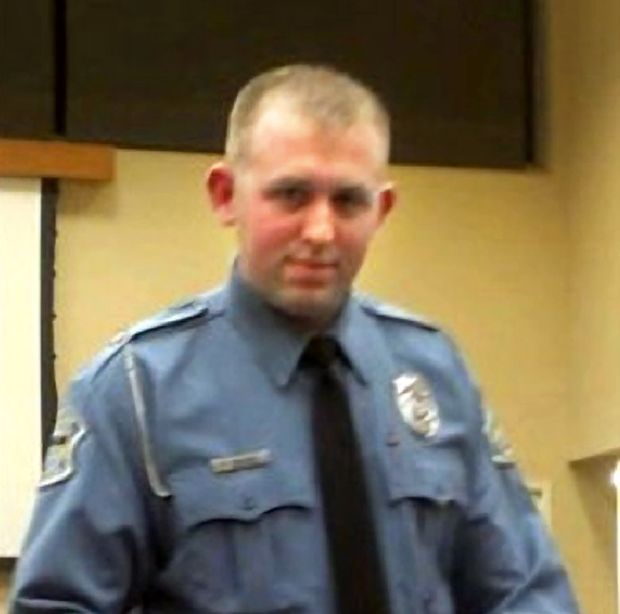
On Friday, police finally identified the officer as Darren Wilson, who is said to have no disciplinary record, as such records are kept in Ferguson. We already know that he started out at a time when it was accepted for a Ferguson cop to charge somebody with property damage for bleeding on his uniform and later saying there was no blood on him at all.

CNN reports "Broken Eye Socket" didn't happen to Ferguson officer who shot unarmed teen as reported

Earlier this week, Fox News reported that Darren Wilson, the Ferguson police officer who shot and killed 18-year-old unarmed Michael Brown, suffered a fractured eye socket following his confrontation with the teenager. The reporter, Hollie McKay, cited a “source close to the [police] department’s top brass” as providing that information to the network.


However, on CNN Thursday, Don Lemon reported that Wilson did not suffer a fractured or broken eye socket and was rather treated at the hospital for swelling around his face and eyes. Noting that that specific injury has not been reported by CNN, “but is making its way around other media organization,” Lemon cited a “source close to the investigation” who told CNN that Wilson’s x-rays came back negative for a fractured eye socket.

“That source says it is not true, at all, he did not have a torn eye socket,” Lemon said. “Unequivocally

Tuesday, August 19, 2014

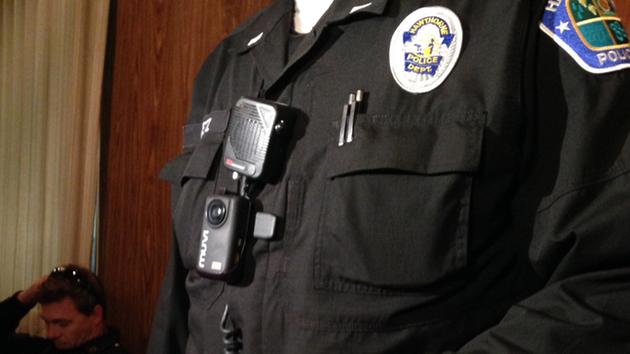
HAWTHORNE MAYOR WANTS COPS TO WEAR CAMERAS

undefinedHawthorne Mayor Chris Brown is calling for all police officers to wear cameras, saying it's time to take action to protect the people of his city.
The move comes following the controversial police killing if 18-year-old Michael Brown in Ferguson, Missouri.

"In light of recent events, it is clear the safety of our civilians and uniformed officers is not guaranteed," Brown said in a statement posted on Twitter. "I am simply not willing to gamble with a single life, or the wrongful accusation of upstanding officers."

Brown said the ordinance would be introduced at the Hawthorne City Council meeting on Aug. 26.

Two high school students suspected of plotting a school massacre has been arrested in plot after Web activities eyed

SOUTH PASADENA, Calif. — Two high school students suspected of plotting a school massacre in a Los Angeles suburb were arrested after investigators monitored their Internet activities and determined they presented a real threat, police said Tuesday.
The boys, ages 16 and 17, named three staffers they planned to kill and said they would target random students, police said.
"They were making a huge, a huge plan of a school massacre," South Pasadena Police Chief Arthur Miller said. "They just wanted to kill as many people as possible."
Miller said his officers saved lives by thwarting the attack in the quaint town of about 25,000 people known for its high-quality schools and community involvement in education.
School officials heard about the plot and notified police, who began watching the boys and monitoring their online activity. They had no weapons or date for a possible attack, but they were researching automatic weapons, handguns, knives and explosives, police said.
One boy allegedly said he had a relative with a gun that he might be able to get. Police contacted that relative, who said that the weapon was secured.
Miller said police realized how cold-hearted the plot was after interrogating the boys.
The two teenage boys were arrested on charges of making threats and conspiracy. They were being held at a juvenile facility.
Miller didn't name the boys or provide information about the dynamic of their relationship.
Police expect to present their case to the district attorney later in the day.
The FBI joined the investigation to help search for evidence on the computers seized from the boys' homes.
Police plan to have a larger presence on South Pasadena High School campus Thursday for the first day of school.

Tuesday, August 12, 2014

Racial tensions are not new in Ferguson, this St. Louis suburb. 50 of the cities 53 officers are WHITE

Racial tensions have run high for decades in this former railroad town that was once a mostly white St. Louis suburb until school busing and urban decay sent many families packing for more distant communities

Today, Ferguson is nearly 70 percent black, but the law here is still enforced by a police department that is more than 90 percent white, a fact that helps engender widespread distrust of officers — never more so than last weekend, when a white officer shot and killed an unarmed young black man who was about to start college.

Ferguson Police Chief Thomas Jackson said 50 of the city's 53 police officers are white. He said he made recruiting and promoting black officers a priority when he took over four years ago after a three-decade police career in St. Louis and St. Louis County.

Jackson said he promoted two black officers to sergeant in his first year in Ferguson, though one of those officers has since left for a better-paying job.

"I'm constantly trying to recruit African-Americans and other minorities," he said. "But it's an uphill battle. The minority makeup of this police department is not where I want it to be."

The town of 21,000 has been on edge since Michael Brown, 18, and another teenager were confronted by an officer Saturday near Brown's apartment. Police say one of the teens shoved the officer back into his car and a struggle ensued. Brown was struck by several bullets after emerging from the car.

Eyewitnesses have said Brown was raising his hands in surrender and that the officer kept firing. Authorities had said they would release the officer's name Tuesday but later decided not to, citing death threats against the officer.

The FBI and St. Louis County police are conducting separate investigations.

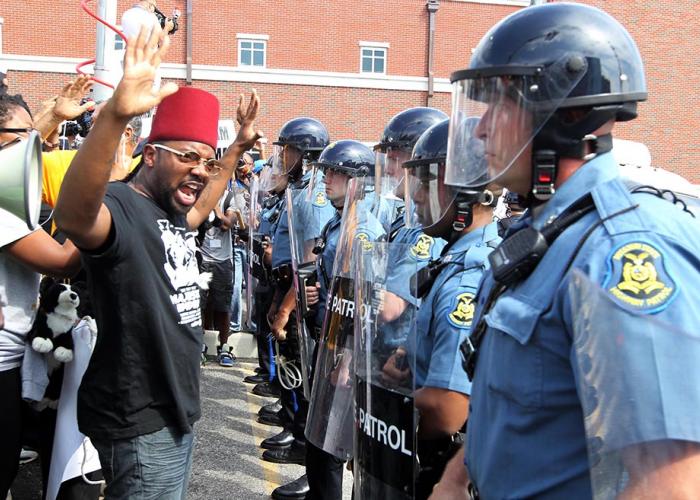
The shooting sparked two nights of unrest. Looting broke out late Sunday at dozens of stores in Ferguson and neighboring communities. On Monday night, police used tear gas and fired "bean bag" rounds after a crowd turned rowdy, throwing rocks and bottles at officers. No serious injuries were reported.

Ferguson was once a middle-class suburban town known for its sprawling parks and tidy brick homes. For many years, it was largely white.

Over the past few decades, the demographics changed. As St. Louis city schools deteriorated, a voluntary busing program started in the 1980s that allowed parents to send their children to suburban districts. Some black families decided to leave the city, and the crime, behind and moved to nearby suburbs like Ferguson.

As more black residents moved in, whites in Ferguson began to move to outer suburbs.

The elected leadership of Ferguson — the mayor and four of the five aldermen — are also white.

Mayor James Knowles III said he's having a hard time with the image of Ferguson as a racially divided, riot-torn place.

"We're all broken-hearted, regardless of our race," Knowles said. "This is not representative of our community."

Some of the town's young blacks feel unfairly targeted by police.

Jarrett Snider, 19, said he was stopped while walking in his neighborhood. He showed his identification, but the officer still called for several backup units.

"You get harassed," said Snider, who lives in the apartment complex near where Brown was shot and described himself as a good friend of Brown. "It's too much ... Mike's situation is not the first time."

Stephen Bussey, 29, said he was recently stopped by an officer while walking to a convenience store before his pre-dawn shift at a fast-food restaurant.

"The cop told me I looked like a guy who robbed a bank nearby," Bussey said. "I didn't make a big deal about it. But since when is walking a crime?"

The mayor acknowledged the resentment.

"The African-American community — youth in the African-American community in particular — has something against law enforcement in many ways," Knowles said. "They don't like law enforcement, and they don't think law enforcement likes them."

Knowles said that suspicion is part of the reason the city has so few black officers.

"We don't get nearly as many African-American applicants as we would like," he said.

University of Missouri-St. Louis criminologist David Klinger said there are no reliable statistics on police-involved shootings in the St. Louis region, but he said police in the U.S. kill at least a few hundred suspects every year.

Klinger, who has led two federally funded studies on police shootings and interviewed about 300 officers involved in those incidents, said police often show tremendous restraint, refraining from shooting suspects who come at them with knives or guns. Sometimes, he said, they simply have no choice but to fire.

In other instances, mistakes are made.

"Officers really aren't out there to shoot people," Klinger said. "That doesn't mean there aren't knucklehead cops out there. But the vast majority of officers have held their fire far more often than they've pulled the trigger."

Saturday, August 9, 2014

NYPD Police-mayor tensions mount over chokehold death

William Bratton, Bill de Blasio, Al Sharpton: FILE- In this July 31, 2014 file photo provided by the New York City Mayoral Photography Office, New York Mayor Bill de Blasio, center, is seated between New York City Police Commissioner William Bratton, left, and the Rev. Al Sharpton, during a round table discussion convened to ease tensions over the July 17, police involved death of Eric Garner.Police have become increasingly at odds with Mayor Bill de Blasio over the appearance he is taking sides against them after the chokehold death of a black suspect last month — a conflict that has prompted the city's top law enforcement official to do damage control by calling the mayor "very pro-cop." 

What angered many was a recent forum in which the Rev. Al Sharpton, one of the biggest critics of the New York Police Department, was seated alongside the mayor, a liberal Democrat, and the police commissioner as he lambasted law enforcement and suggested the mayor's mixed-race son would be a "candidate for a chokehold" if he were an ordinary New Yorker. The image was seized on by critics of the administration and plastered on the cover of the New York Post with the headline "Who's the Boss!"

"It is outrageously insulting to all police officers to say that we go out on our streets to choke all people of color as Al Sharpton stated while seated at the table right next to our mayor at City Hall," said Patrick Lynch, head of the powerful Patrolmen's Benevolent Association. Another union official, Ed Mullins of the Sergeants Benevolent Association, hinted at a work slowdown at the nation's largest police department.

Former Mayor Rudolph Giuliani even weighed in, saying in a radio interview thatde Blasio made a "big mistake .... setting up a press conference like that and putting a police commissioner in that situation. That's extremely damaging to the police commissioner, to keep up the morale of the police."

In recent days, emails have circulated among police officers showing a mock identification card with a picture of Sharpton and the title "Police Commissioner." The activist has shot back by claiming he has the ear of federal officials who have the authority to bring civil rights charges in the death of Eric Garner.

"It is time to have a mature conversation about policing rather than immature name calling and childish attempts to scapegoat," Sharpton said in a statement.

Bratton responded to the uproar by giving a series of interviews Friday defending his department's record on race and de Blasio's attitude toward the department.

"We are not a racist organization," Bratton told The Associated Press. "And I will challenge anybody despite their perceptions of police on that issue. This is a department that goes where the problems are — whether it's crime or disorder."

De Blasio, he added, "is very pro-cop. ... This is not an anti-police mayor."

The rift stems from Eric Garner's arrest on suspicion of selling loose, untaxed cigarettes in Staten Island. Amateur video appears to show an officer putting the asthmatic, 350-pound father of six in a banned chokehold after he refused to be handcuffed. He yells, "I can't breathe!" as several officers take him down.

A city medical examiner found that the 43-year-old Garner was killed by neck compression from the chokehold along with "the compression of his chest and prone positioning during physical restraint by police." Asthma, heart disease and obesity were contributing factors.

The finding increased the likelihood that the case will be presented to a grand jury to determine whether any of the arresting officers will face criminal charges. It also has fueled the biggest crisis yet for de Blasio, who took office this year vowing to achieve two goals that, at times, can be contradictory: He said he would drive down crime and repair strained relations between police and the community.

"Every law enforcement official, every officer has to serve the people in this city," the mayor said. "The vast majority of people in the NYPD take that very, very seriously. If some individuals don't, that's a problem for us because we need people to go out there and do our jobs and do them well."

Some lawmakers and experts say the decades-old theory no longer applies to a city with far less crime, unnecessarily puts nonviolent people at risk and fuels tensions in the city's minority communities.

"Serious crime has decreased dramatically in New York City in the two decades that broken windows policing has been in force, yet the causal connection between that drop and huge numbers of arrests for minor transgressions is unproven to this day," Steve Zeidman, a law professor at City University of New York, wrote in a recent op-ed piece.

Bratton has insisted that the NYPD will stick with the tactic. He also has defended the powwow with Sharpton.

"Whether you like Al Sharpton or not, he clearly is a spokesperson, particularly for African-Americans, and that is reality," Bratton sai