Showing posts with label michael brown. Show all posts

Tuesday, November 25, 2014

Michael Brown's killer goes free! No charges for Police officer Darren Wilson / Shameful

I don't condone burning down your community, or looting. Not all police officers are bad, and not all men of color are criminals.

We can all sit home and judge others.  However, how would you feel if this were your family, or friend, shot 6 times and left to DIE in the middle of the street for 4 hours in the heat, with no medical assistance.

It's shameful and unfair, that police office Darren Wilson was not charged with anything, after shooting an unarmed man 6 times. How much of a threat could Michael Brown have been to a man with a gun. How can the police, government or citizens look beyond the fact, that an unarmed teen was gunned down in the middle of the street with 6 bullets in his body.

This deadly force has to stop. There are so many other ways to stop and unarmed man. What ever happened to the stun-gun, or just shooting the assailant in the leg to stop them.

Why are police forces hiring men who can't protect themselves without shooting their weapons?

You can't even get away with this during WAR TIME.  Shooting someone unarmed, has gotten so many soldiers locked up. America, please release our soldiers who have killed the  enemy in war, because it seems to be legal to kill an unarmed American citizen right here at home.

America still has lots of work to be done, to bring equality to all Americans regardless of skin color, religion, sexual orientation or disability.

We claim that we're a christian nation, however, we hate our neighbors because they believe differently than we do. Because they look different than we do. The bible says in I John 4:20, Whoever claims to love God yet hates a brother or sister is a liar. For whoever does not love their brother and sister, whom they have seen, cannot love God, whom they have not seen. That scripture's talking about your christian sister's and brother's. Your neighbors.

Get it together America!

My mantra is, I Love me, no matter what.  So love yourself no matter what.

Sunday, August 24, 2014

UNARMED IN AMERICA A MUST WATCH VIDEO, MICHAEL BROWN, ERIC GARNER AND MANY OTHERS

CLICK TO WATCH Unarmed in America! Alarming Video

Ferguson Cops Were Caught in a Bloody Lie: The officers got the wrong man, but charged him anyway—with getting his blood on their uniforms after beating him to a pulp

The officers got the wrong man, but charged him anyway—with getting his blood on their uniforms. How the Ferguson PD ran the town where Michael Brown was gunned down.
Police in Ferguson, Missouri, once charged a man with destruction of property for bleeding on their uniforms while four of them allegedly beat him.

“On and/or about the 20th day of Sept. 20, 2009 at or near 222 S. Florissant within the corporate limits of Ferguson, Missouri, the above named defendant did then and there unlawfully commit the offense of ‘property damage’ to wit did transfer blood to the uniform,” reads the charge sheet.

The address is the headquarters of the Ferguson Police Department, where a 52-year-old welder named Henry Davis was taken in the predawn hours on that date. He had been arrested for an outstanding warrant that proved to actually be for another man of the same surname, but a different middle name and Social Security number.

“I said, ‘I told you guys it wasn’t me,’” Davis later testified.

He recalled the booking officer saying, “We have a problem.”

The booking officer had no other reason to hold Davis, who ended up in Ferguson only because he missed the exit for St. Charles and then pulled off the highway because the rain was so heavy he could not see to drive. The cop who had pulled up behind him must have run his license plate and assumed he was that other Henry Davis. Davis said the cop approached his vehicle, grabbed his cellphone from his hand, cuffed him and placed him in the back seat of the patrol car, without a word of explanation.

But the booking officer was not ready just to let Davis go, and proceeded to escort him to a one-man cell that already had a man in it asleep on the lone bunk. Davis says that he asked the officer if he could at least have one of the sleeping mats that were stacked nearby.

”He said I wasn’t getting one,” Davis said.

Davis balked at being a second man in a one-man cell.

“Because it’s 3 in the morning,” he later testified. “Who going to sleep on a cement floor?”

The booking officer summoned a number of fellow cops. One opened the cell door while another suddenly charged, propelling Davis inside and slamming him against the back wall.

“I told the police officers there that I didn’t do nothing, ‘Why is you guys doing this to me?’” Davis testified. “They said, ‘OK, just lay on the ground and put your hands behind your back.’”

Davis said he complied and that a female officer straddled and then handcuffed him. Two other officers crowded into the cell.

“They started hitting me,” he testified. “I was getting hit and I just covered up.”

The other two stepped out and the female officer allegedly lifted Davis’ head as the cop who had initially pushed him into the cell reappeared.

“He ran in and kicked me in the head,” Davis recalled. “I almost passed out at that point… Paramedics came… They said it was too much blood, I had to go to the hospital.”

A patrol car took the bleeding Davis to a nearby emergency room. He refused treatment, demanding somebody first take his picture.

“I wanted a witness and proof of what they done to me,” Davis said.

He was driven back to the jail, where he was held for several days before he posted $1,500 bond on four counts of “property damage.” Police Officer John Beaird had signed complaints swearing on pain of perjury that Davis had bled on his uniform and those of three fellow officers.

The remarkable turned inexplicable when Beaird was deposed in a civil case that Davis subsequently brought seeking redress and recompense.

“After Mr. Davis was detained, did you have any blood on you?” asked Davis’ lawyer, James Schottel.

“No, sir,” Beaird replied.

Schottel showed Beaird a copy of the “property damage” complaint.

“Is that your signature as complainant?” the lawyer asked.

“It is, sir,” the cop said.

“And what do you allege that Mr. Davis did unlawfully in this one?” the lawyer asked.

“Transferred blood to my uniform while Davis was resisting,” the cop said.

“And didn’t I ask you earlier in this deposition if Mr. Davis got blood on your uniform?”

“You did, sir.”

“And didn’t you respond no?”

“Correct. I did.”

Beaird seemed to be either admitting perjury or committing it. The depositions of other officers suggested that the “property damage” charges were not just bizarre, but trumped up.

“There was no blood on my uniform,” said Police Officer Christopher Pillarick.

And then there was Officer Michael White, the one accused of kicking Davis in the head, an allegation he denies, as his fellow officers deny striking Davis. White had reported suffering a bloody nose in the mayhem.

“Did you see Mr. Davis bleeding at all?” the lawyer, Schottel, asked.

“I did not,” White replied.

“Did Mr. Davis get any blood on you while you were in the cell?” Schottel asked.

“No,” White said.

The contradictions between the complaint and the depositions apparently are what prompted the prosecutor to drop the “property damage” allegation. The prosecutor also dropped a felony charge of assault on an officer that had been lodged more than a year after the incident and shortly after Davis filed his civil suit.

Davis suggested in his testimony that if the police really thought he had assaulted an officer he would have been charged back when he was jailed.

“They would have filed those charges right then and there, because that’s a major felony,” he noted.

Indisputable evidence of what transpired in the cell might have been provided by a surveillance camera, but it turned out that the VHS video was recorded at 32 times normal speed.

“It was like a blur,” Schottel told The Daily Beast on Wednesday. “You couldn’t see anything.”

The blur proved to be from 12 hours after the incident anyway. The cops had saved the wrong footage after Schottel asked them to preserve it.

Schottel got another unpleasant surprise when he sought the use-of-force history of the officers involved. He learned that before a new chief took over in 2010 the department had a surprising protocol for non-fatal use-of-force reports.

“The officer himself could complete it and give it to the supervisor for his approval,” the prior chief, Thomas Moonier, testified in a deposition. “I would read it. It would be placed in my out basket, and my secretary would probably take it and put it with the case file.”

No copy was made for the officer’s personnel file.

“Everything involved in an incident would generally be with the police report,” Moonier said. “I don’t know what they maintain in personnel files.”

“Who was in charge of personnel files, of maintaining them?” Schottel asked.

“I have no idea,” Moonier said. “I believe City Hall, but I don’t know.”

Schottel focused on the date of the incident.

“On September 20th, 2009, was there any way to identify any officers that were subject of one or more citizens’ complaints?” he asked.

“Not to my knowledge,” Moonier said.

“Was there any way to identify any officers who had completed several use-of-force reports?”

“I don’t recall.”

But however lax the department’s system and however contradictory the officers’ testimony, a federal magistrate ruled that the apparent perjury about the “property damage” charges was too minor to constitute a violation of due process and that Davis’ injuries were de minimis—too minor to warrant a finding of excessive force. Never mind that a CAT scan taken after the incident confirmed that he had suffered a concussion.

Schottel has appealed and expects to argue the case in December. He will contend that perjury is perjury however minor the charge and note that both the NFL and Major League Baseball have learned to consider a concussion a serious injury.

Schottel figures the courts might take the problems of the Ferguson Police Department as more than de minimis as a result of the protests sparked when an officer shot and killed an unarmed 18-year-old named Michael Brown on the afternoon of Aug. 9.

“Your chances on appeal are going up,” a fellow lawyer told him.

At least one witness has said that Brown was shot in the back and then in the chest and head as he turned toward the officer with his hands raised.

“I said, ‘Well, that doesn’t surprise me,’” Schottel told The Daily Beast on Wednesday. “I said I already know about Ferguson, nothing new can faze me about Ferguson.”

Schottel has also deposed the new chief, Thomas Jackson, who took over in 2010. Jackson testified that he has instituted a centralized system whereby all complaints lodged against cops by citizens or supervisors go through him and are assigned a number in an internal affairs log. Schottel views Jackson as “not a bad guy,” someone who has been trying to make positive change.

“He wants to do right, but it was such a mess,” Schottel said Wednesday.

Jackson has seemed less than progressive as he delayed identifying the officer involved in the shooting for fear it would place him and his family in danger. Jackson would only say the officer is white and has been on the job for six years. This means that for his first two and most formative years the officer might have been writing his own force reports and that none of them went into his file.

“It’s hard to get people to clean things up, especially if they’re used to doing things a certain way,” Schottel said.


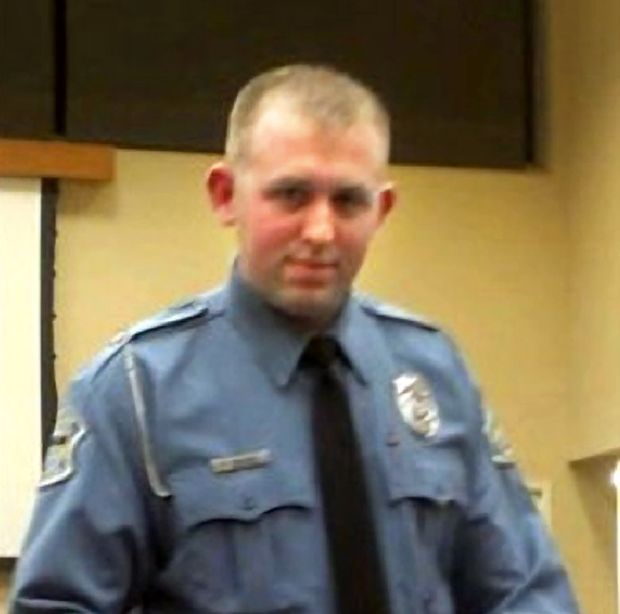
On Friday, police finally identified the officer as Darren Wilson, who is said to have no disciplinary record, as such records are kept in Ferguson. We already know that he started out at a time when it was accepted for a Ferguson cop to charge somebody with property damage for bleeding on his uniform and later saying there was no blood on him at all.

The photographer who captured the iconic image of Ferguson was arrested

Chris Hayes reported on MSNBC that Scott Olson was arrested for going beyond an area where the police were trying to cordon off the media.

Scott has been released from Jail.

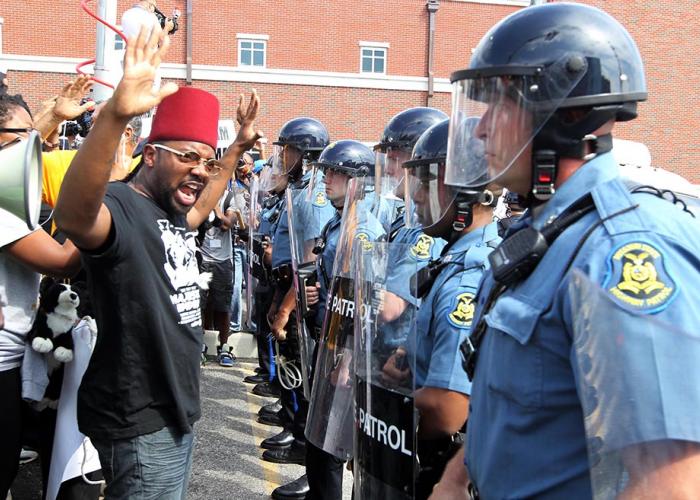
Iconic Image #1


Iconic Image #2

CNN reports "Broken Eye Socket" didn't happen to Ferguson officer who shot unarmed teen as reported

Earlier this week, Fox News reported that Darren Wilson, the Ferguson police officer who shot and killed 18-year-old unarmed Michael Brown, suffered a fractured eye socket following his confrontation with the teenager. The reporter, Hollie McKay, cited a “source close to the [police] department’s top brass” as providing that information to the network.


However, on CNN Thursday, Don Lemon reported that Wilson did not suffer a fractured or broken eye socket and was rather treated at the hospital for swelling around his face and eyes. Noting that that specific injury has not been reported by CNN, “but is making its way around other media organization,” Lemon cited a “source close to the investigation” who told CNN that Wilson’s x-rays came back negative for a fractured eye socket.

“That source says it is not true, at all, he did not have a torn eye socket,” Lemon said. “Unequivocally

Monday, August 18, 2014

Autopsy Shows unarmed teen Michael Brown Was Struck at Least 6 Times

Dr. Michael Baden, right, and Prof. Shawn Parcells in Ferguson, Mo. Dr. Baden, based in New York, examined Michael Brown.

FERGUSON, Mo. — Michael Brown, the unarmed black teenager who was killed by a police officer, sparking protests around the nation, was shot at least six times, including twice in the head, a preliminary private autopsy performed on Sunday found.

One of the bullets entered the top of Mr. Brown’s skull, suggesting his head was bent forward when it struck him and caused a fatal injury, according to Dr. Michael M. Baden, the former chief medical examiner for the City of New York, who flew to Missouri on Sunday at the family’s request to conduct the separate autopsy. It was likely the last of bullets to hit him, he said.

Mr. Brown, 18, was also shot four times in the right arm, he said, adding that all the bullets were fired into his front.


The bullets did not appear to have been shot from very close range because no gunpowder was present on his body. However, that determination could change if it turns out that there is gunshot residue on Mr. Brown’s clothing, to which Dr. Baden did not have access.

Attorney General Eric H. Holder Jr.said Sunday that the Justice Department would conduct its own autopsy, in addition to the one performed by local officials and this private one because, a department spokesman said, of “the extraordinary circumstances involved in this case and at the request of the Brown family.”

The preliminary autopsy results are the first time that some of the critical information resulting in Mr. Brown’s death has been made public. Thousands of protesters demanding information and justice for what was widely viewed as a reckless shooting took to the streets here in rallies that ranged from peaceful to violent.

Mr. Brown died Aug. 9 in a confrontation with a police officer here in this suburb of St. Louis. The police department has come under harsh criticism for refusing to clarify the circumstances of the shooting and for responding to protests with military-style operational gear.

“People have been asking: How many times was he shot? This information could have been released on Day 1,” Dr. Baden said in an interview after performing the autopsy. “They don’t do that, even as feelings built up among the citizenry that there was a cover-up. We are hoping to alleviate that.”

Dr. Baden said that while Mr. Brown was shot at least six times, only three bullets were recovered from his body. But he has not yet seen the X-rays showing where the bullets were found, which would clarify the autopsy results. Nor has he had access to witness and police statements.

Dr. Baden provided a diagram of the entry wounds, and noted that the six shots produced numerous wounds. Some of the bullets entered and exited several times, including one that left at least five different wounds.

“This one here looks like his head was bent downward,” he said, indicating the wound at the very top of Mr. Brown’s head. “It can be because he’s giving up, or because he’s charging forward at the officer.”

He stressed that his information does not assign blame or justify the shooting.

“We need more information; for example, the police should be examining the automobile to see if there is gunshot residue in the police car,” he said.

Dr. Baden, 80, is a well-known New York-based medical examiner, who is one of only about 400 board-certified forensic pathologists in the nation. He reviewed the autopsies of both President John F. Kennedy and the Rev. Dr. Martin Luther King Jr., and has performed more than 20,000 autopsies himself.

He is best known for having hosted the HBO show “Autopsy,” but he rankles when he is called a “celebrity medical examiner,” saying that the vast majority of what he does has nothing to do with celebrities.

Dr. Baden said that because of the tremendous attention to the case, he waived his $10,000 fee.

Prof. Shawn L. Parcells, a pathologist assistant based in Kansas, assisted Dr. Baden.

“You do this for the families,” Mr. Parcells said.

The two medical experts conducted the four-hour examination Sunday at the Austin A. Layne Mortuary in St. Louis. Benjamin L. Crump, a lawyer for Mr. Brown’s family who paid their travel expenses, hired them.


“The sheer number of bullets and the way they were scattered all over his body showed this police officer had a brazen disregard for the very people he was supposed to protect in that community,” Mr. Crump said. “We want to make sure people understand what this case is about: This case is about a police officer executing a young unarmed man in broad daylight.”

A spokesman for the Ferguson Police Department, Tim Zoll, said the police had not seen a report of the autopsy and therefore had no comment on it.

Dr. Baden said he consulted with the St. Louis County medical examiner before conducting the autopsy.

One of the bullets shattered Mr. Brown’s right eye, traveled through his face, exited his jaw and re-entered his collarbone. The last two shots in the head would have stopped him in his tracks and were likely the last fired.

Mr. Brown, he said, would not have survived the shooting even if he had been taken to a hospital right away. The autopsy indicated that he was otherwise healthy.

Dr. Baden said it was unusual for the federal government to conduct a third autopsy, but dueling examinations often occur when there is so much distrust of the authorities. The county of St. Louis has conducted an autopsy, and the results have not yet been released.

He stressed that his examination was not to determine whether the shooting was justified.

“In my capacity as the forensic examiner for the New York State Police, I would say, ‘You’re not supposed to shoot so many times,’ ” said Dr. Baden, who retired from the state police in 2011. “Right now there is too little information to forensically reconstruct the shooting.”

No matter what conclusions can be drawn from Dr. Baden’s work, Mr. Brown’s death remains marked by shifting and contradictory accounts more than a week after it occurred. The shooting is under investigation by St. Louis County and by the F.B.I., working with the Justice Department’s civil rights division and the office of Attorney General Holder.Photo

Sunday, August 17, 2014

US Justice Dept. to conduct independent autopsy of Missouri shooting victim

U.S. Attorney General Eric Holder on Sunday ordered the Justice Department to conduct an autopsy of Michael Brown, the unarmed black teenager shot and killed by a white police officer in Ferguson, Missouri, a spokesman said.

Justice Department spokesman Brian Fallon said Holder ordered the federal autopsy "due to the extraordinary circumstances involved in this case and at the request of the Brown family."
The autopsy, to be performed by a federal medical examiner, would be in addition to an autopsy by Missouri state medical examiners.
Fallon said federal investigators would take into account the results of the autopsy carried out by the state during their investigation into the shooting of Brown. (Reporting By Julia Edwards; Editing by Mohammad Zargham)
One person was shot and critically wounded and seven arrested early on Sunday as police in  , clashed with protesters when a curfew was imposed following days of unrest over a black teenager being shot dead by a white police officer.
Scores of demonstrators had remained in the streets after the curfew took effect at midnight Law enforcement officials used loudspeakers to warn protesters to disperse immediately. Officers, equipped with gas masks and full-length shields, stood among and on top of armored vehicles.
Governor Jay Nixon declared a state of emergency and announced the five-hour curfew after a week of racially charged protests and looting over the shooting of 18-year-old Michael Brown by Ferguson police officer Darren Wilson, 28, in the suburban St. Louis community in the Midwest U.S. state on Aug. 9.
Missouri State Highway Patrol Captain Ron Johnson said the person shot at a restaurant was in critical condition. Police were unable to identify the victim, who he said was not shot by police, and that the alleged shooter was still at large.
A protester holds a sign aloft in front of police officers before a midnight curfew meant to stem ongoing demonstrations in reaction to the shooting of Michael Brown takes effect in Ferguson, Missouri August 16, 2014.Reuters: Lucas Jackson
A protester holds a sign aloft in front of police officers before a midnight curfew meant to stem ongoing demonstrations in reaction to the shooting of Michael Brown takes effect in Ferguson, Missouri August 16, 2014.
Seven people were also arrested for failing to disperse after the curfew took effect.
Johnson said canisters of smoke and later teargas were fired as part of police attempts to reach the victim of the restaurant shooting, "and not in relation to the curfew." The shooting victim was taken to hospital by bystanders before police could reach him.
Johnson also said someone had shot at a passing police car but was not apprehended, adding "I was disappointed in the actions of tonight," noting "the crowds we've had for the last two nights (were) citizens obeying, protesting."
The smoke and teargas canisters largely dispersed the crowd, some of whom had been chanting "No justice, no curfew, no peace", while others implored the crowd not to move forward towards police.
On Saturday evening the mood among the protesters on a main road in Ferguson had been tense and defiant following days of demonstrations and some looting.
"The curfew is going to make things worse," said protester Phones Scott, 24. "I think the cops are going to get violent tonight, but they can't lock us all up."
Tensions had been running high over the past week but escalated on Friday, pitting mostly black protesters against mostly white police as the demonstrators overran a residential and retail district that has become a center of the unrest.
Brown's family and supporters have demanded that the officer who shot Brown be held accountable. The U.S. Department of Justice is investigating the shooting for any civil rights violations, and the St. Louis County Police department has also launched a probe.
The police version of how Brown was shot differs from witness accounts, including that of the friend who was walking with Brown at the time, Dorian Johnson, 22.
Police say that after Wilson asked Brown to move out of the road onto a sidewalk, Brown reached into the patrol car and struggled with Wilson for the officer's service gun. Wilson, who sustained a facial injury, then shot Brown a number of times.

Tuesday, August 12, 2014

Racial tensions are not new in Ferguson, this St. Louis suburb. 50 of the cities 53 officers are WHITE

Racial tensions have run high for decades in this former railroad town that was once a mostly white St. Louis suburb until school busing and urban decay sent many families packing for more distant communities

Today, Ferguson is nearly 70 percent black, but the law here is still enforced by a police department that is more than 90 percent white, a fact that helps engender widespread distrust of officers — never more so than last weekend, when a white officer shot and killed an unarmed young black man who was about to start college.

Ferguson Police Chief Thomas Jackson said 50 of the city's 53 police officers are white. He said he made recruiting and promoting black officers a priority when he took over four years ago after a three-decade police career in St. Louis and St. Louis County.

Jackson said he promoted two black officers to sergeant in his first year in Ferguson, though one of those officers has since left for a better-paying job.

"I'm constantly trying to recruit African-Americans and other minorities," he said. "But it's an uphill battle. The minority makeup of this police department is not where I want it to be."

The town of 21,000 has been on edge since Michael Brown, 18, and another teenager were confronted by an officer Saturday near Brown's apartment. Police say one of the teens shoved the officer back into his car and a struggle ensued. Brown was struck by several bullets after emerging from the car.

Eyewitnesses have said Brown was raising his hands in surrender and that the officer kept firing. Authorities had said they would release the officer's name Tuesday but later decided not to, citing death threats against the officer.

The FBI and St. Louis County police are conducting separate investigations.

The shooting sparked two nights of unrest. Looting broke out late Sunday at dozens of stores in Ferguson and neighboring communities. On Monday night, police used tear gas and fired "bean bag" rounds after a crowd turned rowdy, throwing rocks and bottles at officers. No serious injuries were reported.

Ferguson was once a middle-class suburban town known for its sprawling parks and tidy brick homes. For many years, it was largely white.

Over the past few decades, the demographics changed. As St. Louis city schools deteriorated, a voluntary busing program started in the 1980s that allowed parents to send their children to suburban districts. Some black families decided to leave the city, and the crime, behind and moved to nearby suburbs like Ferguson.

As more black residents moved in, whites in Ferguson began to move to outer suburbs.

The elected leadership of Ferguson — the mayor and four of the five aldermen — are also white.

Mayor James Knowles III said he's having a hard time with the image of Ferguson as a racially divided, riot-torn place.

"We're all broken-hearted, regardless of our race," Knowles said. "This is not representative of our community."

Some of the town's young blacks feel unfairly targeted by police.

Jarrett Snider, 19, said he was stopped while walking in his neighborhood. He showed his identification, but the officer still called for several backup units.

"You get harassed," said Snider, who lives in the apartment complex near where Brown was shot and described himself as a good friend of Brown. "It's too much ... Mike's situation is not the first time."

Stephen Bussey, 29, said he was recently stopped by an officer while walking to a convenience store before his pre-dawn shift at a fast-food restaurant.

"The cop told me I looked like a guy who robbed a bank nearby," Bussey said. "I didn't make a big deal about it. But since when is walking a crime?"

The mayor acknowledged the resentment.

"The African-American community — youth in the African-American community in particular — has something against law enforcement in many ways," Knowles said. "They don't like law enforcement, and they don't think law enforcement likes them."

Knowles said that suspicion is part of the reason the city has so few black officers.

"We don't get nearly as many African-American applicants as we would like," he said.

University of Missouri-St. Louis criminologist David Klinger said there are no reliable statistics on police-involved shootings in the St. Louis region, but he said police in the U.S. kill at least a few hundred suspects every year.

Klinger, who has led two federally funded studies on police shootings and interviewed about 300 officers involved in those incidents, said police often show tremendous restraint, refraining from shooting suspects who come at them with knives or guns. Sometimes, he said, they simply have no choice but to fire.

In other instances, mistakes are made.

"Officers really aren't out there to shoot people," Klinger said. "That doesn't mean there aren't knucklehead cops out there. But the vast majority of officers have held their fire far more often than they've pulled the trigger."